-
The tight pallet load that blocks return air
-
Why moving air, not capacity, cools the cargo
-
Find the discharge and return paths first
-
Build the load back to front, floor clear
-
A two-minute walk-round before the doors shut
-
What open air channels cost you in payload
-
Short multi-stop runs still need the same paths
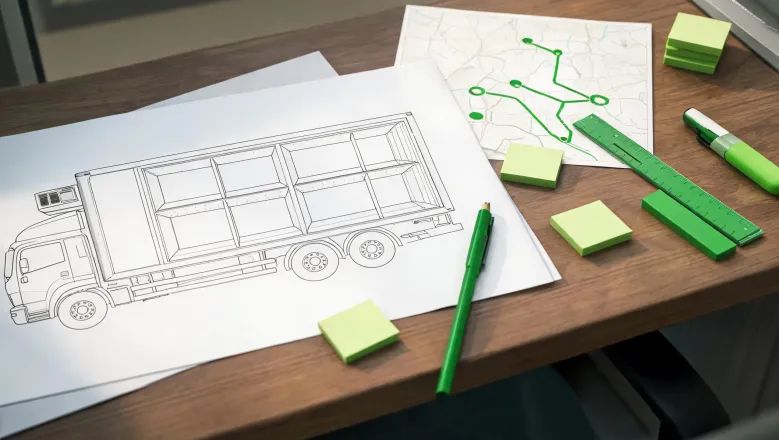
A dispatcher walks past an open rear door, sees the box packed floor to ceiling with pallets squared against the front bulkhead, and calls it a good load. Nothing rattles, nothing is wasted, the door closes without a shove. It is also the load most likely to come back with a claim on it. In a 4x2 refrigerated van the front bulkhead is where the evaporator sits, and freight pushed tight against it covers the return air inlet, the opening the unit pulls compartment air back through. The reefer keeps running, the display keeps showing a number, and the middle of the pallet stack never gets cold.
What that costs is not obvious on the first trip. Restricted airflow means the unit works longer to move the same heat, so it runs harder, and product damage follows because air is not reaching the cargo properly. The conclusion worth putting in a loading sheet is that airflow is a load-building decision, not a thermostat setting; the setpoint can only describe the air the sensor can see. What follows is the loading sequence for the cited 4x2 refrigerated van truck example, built on a Thermo King C-Series vehicle-powered truck refrigeration operator manual and that manufacturer's food safety guidance. Clearances and the air circulation diagram come from the unit's own documentation, not from a universal van layout.
The tight pallet load that blocks return air
The mistake repeats for a boring reason: a tight load is easier to secure and looks like craft. Loaders slide pallets until they touch, stack until the ceiling stops them, and cram it tight because every gap feels like freight left on the dock. Then the last pallet covers the return inlet, and that is the part that bites you, not on the dock but hours later, when the middle of the load is warm.
The unit's instructions are blunt. Do not block unit evaporator outlet or the return air inlet as it restricts air flow, and return air must be unobstructed as restricted airflow can cause product damage due to air not reaching cargo properly. The wider point is stated just as plainly: poor air distribution is one of the primary causes of product deterioration even when unit capacity is more than adequate. A 4x2 van with a healthy unit and a covered inlet is exactly that case: capacity on paper, no cold where it counts.
The correct habit is not loose loading. It is the same cube with the paths left open: pallets set slightly off the bulkhead, the return opening visible from the rear door, the floor line under the freight still able to pass air.
Why moving air, not capacity, cools the cargo
The evaporator cools air. It cannot cool a box except through the air that touches its surface. Heat leaves the cargo by convection: air warms as it passes, the unit pulls that warmed air back through the return, and the loop repeats. Because the only route between the coil and the product is that loop, anything that interrupts it interrupts cooling itself, however much spare capacity the unit carries.
The reason a well-specified reefer still lands a soft claim is therefore geometric, not mechanical: obstructions between pallets, at the floor, or against the walls break the loop into pockets, and each pocket becomes a hot spot. Which means the number on the controller describes what the return air is doing, not what the center of the stack is doing. Heat-removal rate tracks air contact with the load, which is why more capacity cannot rescue a bad load plan: a bigger coil pulling through the same blocked channels moves the same air.
Find the discharge and return paths first
Before the first pallet goes in, walk to the front of the box and find two things: where the evaporator discharges cold air and where it pulls return air back in. The rule is written as one line, do not block the evaporator inlet or outlet, and the return side gets repeated on its own because that is the one loaders cover first.
The manual then points to an air circulation diagram on the following page, and that diagram is the part worth taping inside the door. It is unit-specific: the flow pattern and clearances for this cited example come from the Thermo King C-Series vehicle-powered truck refrigeration operator manual covering those units and controllers. A different body or unit can route air differently, so the drawing that matters is the one that shipped with the equipment in your fleet.
Once those two openings are marked, the load plan becomes a geometry problem with a fixed constraint: every pallet position either leaves those paths open or does not.
Build the load back to front, floor clear
Work in a fixed order so the channels survive to the last stop.
Start at the front, but not against it. Load the product so that sufficient air space is maintained around and through the load, with airflow around the cargo unrestricted. In practice, the first row sets back far enough that the return opening stays visible and the discharge stream is not firing into a flat wall of cartons.
Then build rearward, keeping gaps between pallets. Obstructions between pallets are a named cause of poor airflow, and a solid block from wall to wall leaves the air no vertical path. Open a slot between rows instead of shaving the gap somewhere else.
The step that gets skipped is the floor. Do not obstruct the floor under the cargo, because air that cannot travel under the load cannot reach the load, and the result is a hot spot in the bottom layer where nobody looks. Pallet feet are part of the air channel, not a handling convenience.
Two dock shortcuts work against all of this. Slip sheets and hand stacking are not good for temperature management, since both raise the risk of improper spacing that limits air channels. If your dock defaults to either, the sequence above has to be enforced by a supervisor rather than left to the loader's judgment.
A two-minute walk-round before the doors shut
The confirmation is visual and takes less time than closing the door. From the rear, in this order: the return inlet, the discharge outlet, then the floor line under the load.
The return check decides the trip. If the opening is not visible from the back of the box, the load moves: the return air path has to be unobstructed, and a covered inlet is a failure the unit cannot compensate for. The discharge check catches the opposite error, cartons stacked into the cold air stream split it and leave the far end of the box in still air. The floor check finds the pallet sitting on a slip sheet with its feet buried.
None of these checks needs an instrument, and none of them replaces one. The pass criteria are the manual's own wording: space maintained around and through the load, paths not blocked, floor not obstructed. Before you change a layout permanently, read the diagram that came with your unit. The walk-round confirms the plan; it does not invent dimensions.
What open air channels cost you in payload
Suppose a route is planned at a full pallet count in a 4x2 van, and opening the return path while keeping the floor channels free costs one position, either left empty or restacked lower. That is a real cost, and pretending otherwise is how loading sheets get ignored.
The trade is worth pricing properly. On one side sits the cube you gave up on that run. On the other sits the documented failure mode: obstructions between pallets, at the floor, and against the walls create hot spots, and a hot spot is a claim plus a unit that ran at full output for the whole trip. A unit that runs constantly because return air is starved also logs the hours, and hours are what eventually send it to the shop.
Where the trade is genuinely unclear is clearance. No universal dimensions are given here, so no number belongs in a loading sheet unless it comes from the documentation for your unit or from the body builder's specification. Keep the qualitative rule everywhere: paths open, floor clear, gaps between pallets, and get the number from the people who built the box.
Short multi-stop runs still need the same paths
The objection usually arrives here: the box is already cold and the drops are short, so does distribution still matter on a short run?
Distribution is what these failures get blamed on even when capacity is more than adequate, and the return air requirement carries no trip-length qualifier: return air must be unobstructed, full stop. Which means a short run buys nothing on this point. A covered inlet is a covered inlet at the first stop and at the last one.
There is a second reason multi-drop routes are the harder case. Every time part of the load comes out, the remaining pallets shift, gaps close, and a load that passed the walk-round at the first stop can be blocking the inlet by the third. So the check repeats at each stop where freight leaves, and the dock is not the last place it happens.
Budget the cube, then, instead of arguing about it at the door. If the route cannot carry a full pallet count with the return path open, that is a route-planning number, not a loading-crew problem, and it is cheaper to find in the office than in a claim.

Discuss this requirement
Use the procurement form for questions tied to your cargo operation. This is a sourcing inquiry, not a public comment or purchase agreement. Include the vehicle quantity and destination so open requirements can be reviewed in context.